

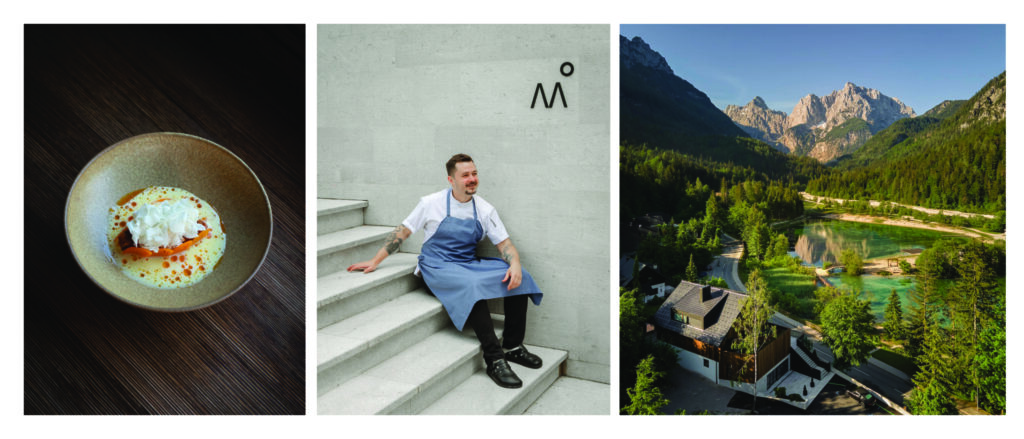
“By demonstrating that a restaurant can operate differently, we can bring lasting change to the hospitality industry.” David Zefran has strong convictions. The chef of Restaurant Milka in Slovenia, a member of the association Les Grandes Tables du Monde, shares with us his global vision of a restaurant. An interview with a self-taught, sincere, and committed chef.
For David Zefran, a restaurant functions as a whole. It is impossible for the chef of Milka to prioritize his commitments, because they are interdependent and form a whole. For him, reducing waste is no more important than treating staff fairly, limiting working hours, or building an environment where everyone feels safe. A tangible local impact that extends beyond the walls of the restaurant through the transmission of his values: those who work at Milka then move on to other projects and apply these principles. “In this way, ideas spread in a concrete and meaningful manner,” David tells us.


Humility in the kitchen
Milka’s location, just a stone’s throw from Lake Jasna in Slovenia, calls for humility. David’s self-taught journey fits with complete sincerity into this grandiose landscape. With no signature dish and no convoluted titles, he creates a cuisine that is hybrid between Slovenia and the Alps, with infinite respect for simple products and a particular fondness for milk and dairy products, inspired by his parents’ farming work. As an illustration, he presents a recipe that reflects who he is: “The Pumpkin,” of which he shares a few details: “Crispy pork rind, chili jam, smoked quince, reduced whey, chestnuts sliced into thin shavings, and fermented physalis sauce.”
The CŒUR DES CHEFS Portrait Series
David Zefran took part in the Cœur des Chefs question-and-answer session for this portrait series produced with the association Les Grandes Tables du Monde to present its members established in every corner of the globe. At the end of the interview, he also tells us about “his last slap in the face” at the restaurant Amelia, and his next destination at Jordnaer (among others!).

Read below for the full-length version of David Zefran’s interview!
A few words to describe the guest experience you wish to offer, and your vision of hospitality: What would you like your guests to feel in your restaurant?
At Milka, I wish to offer an experience that sits between two familiar feelings. The first is a childhood home, where there is warmth, structure, and a nurturing sense of care. The second is a friend’s place, where you feel relaxed and have fun. I want Milka to be a combination of both, for guests to feel comfortable and relaxed, and to feel that they are completely taken care of. We want them to feel as if they already know the place, and to naturally long to return.
For me, hospitality also means understanding that a restaurant and the people inside it influence society. Through our decisions, we show how much responsibility we take towards our environment and our community. Dining is a simple act, but the system behind it has an impact. Through those decisions, we can influence our environment in a practical way.

Your restaurant is committed: which of your social or environmental commitments matters most to you, and why?
« Changing the hospitality industry means demonstrating that a restaurant can function differently. For me, everything matters because the restaurant operates as a whole. It is not more important to reduce waste than it is to treat staff fairly, to limit working hours, or to build an environment where people feel safe. These elements are interconnected.
I do not separate our commitments because they form one system. It would make no sense to speak about environmental responsibility while ignoring working conditions. At the same time, fair treatment of staff without environmental awareness would also be incomplete.
Credibility comes from coherence. We often treat a restaurant as simply a place to eat, but it is more than that. When guests choose to come and return, they enable a certain model to exist. Their support allows us to invest in responsible sourcing, fair labour policies, and long-term local impact. It also supports the growth of regional producers and artisans who are part of our ecosystem. The changes we implement inside the company inevitably extend outward. If the people who work here and develop within this framework move onto new projects, open their own restaurants or bars, they may apply similar principles. In that way, ideas spread in a tangible and meaningful way, through practice. »

What do you love most about your establishment?
The view, because it keeps us humble. When you look at the mountains surrounding us, you realise that nothing we create can be as beautiful or majestic. That perspective keeps us grounded.

Is there one dish that is especially meaningful to you, and that reflects who you are as a chef? Could you describe it and tell us why it holds such importance in your culinary identity?
« I hold our squash close to my heart, as it carries elements of my childhood and peasant, farmer roots. It uses humble ingredients and also reflects my development and understanding as a chef. Through technique and experience, I try to take something simple and draw out its full potential, without losing its character. When it works, the result becomes more than the sum of its parts. In that sense, the dish reflects both my heritage and my evolution. «
Pumpkin with crispy pork rind – chili jam, smoked quince, reduced whey, chestnuts sliced into thin shavings, and fermented physalis sauce.

What has been your most memorable experience at another Grandes Tables du Monde restaurant? What made it so special—was it the cuisine, the service, the setting, the people?
« For now, Amelia, at Paulo Airaudo. I really enjoyed the energy of the place, its playfulness, and the attention to detail. «
Which Grande Table would you most like to visit (or revisit), and why?
What draws you to this particular place?
« There are so many that I cannot pick just one. But off the top of my head, I would really like to visit Atomix, Jordnær, Odette, Single Thread, and Schloss Schauenstein ! »


#lecoeurdeschefs #gastronomie #davidzefran #milka #lesgrandestablesdumonde #slovenie
Copyright photos : ©Lana-Špiler,Raisfoto pour Milka.
À lire également, les autres articles consacrés à l’association Les Grandes Tables du Monde
D’autres articles à lire : Tapez « Les Grandes Tables du Monde » dans l’outil Loupe en haut à droite de la page.